
"It's not that deep, bro"
except it is that deep, maybe you're just shallow

We live in the ultimate age of apathy. Not only do people not care, but it’s cringe to care, it’s ‘not cool’ and ‘embarrassing’ and every other social negative you can think of.
We have never lived in an era like this, where it is simultaneously so easy to access information but people don’t want to use that information. We can all see the same things - the same wars (and war crimes for that matter), the same violence, the same dictatorships, the same demonisation of marginalised groups, the same poverty, the same crisis after crisis. Yet, anyone who talks about it with any level of analysis is met with the same infuriating response: “it’s not that deep”.
The “it’s not that deep” brigade are everywhere, but they definitely seem most active in the sphere of falsely cultivated culture wars. We see marginalised groups scapegoated constantly in these artificially generated battles and when these groups talk about their side of it, they’re shot down with four words, told “it’s not that deep”.
Genuinely, I cannot think of a phrase so weaponised to invalidate genuine lived experience and issues. The “it’s not that deep” brigade might not always know they’re using it as a weapon, but that’s what it is is - a tool designed purely to invalidate and ridicule real-world issues.
A trans person wants to talk about their experience of transphobia? It’s not that deep, bro. A person of colour makes a video about the microaggressions they constantly experience? It’s not that deep, bro. A woman calls out misogyny thinly disguised as a joke? It’s not that deep, bro.
And it’s not just about politics and current affairs, it’s about everything. I’ve seen people get excited about the media they consume, wanting to analyse and debate them with nuance, and their comments are flooded with those four bloody words.
There’s a content creator on TikTok who has spoken on this (Jamaal Burkmar - his content his incredible) and he talks a lot about finding something profound in the seemingly trivial. On his page, there is a pinned post where he explains why he does this and proceeds to read the foreword from a book - ‘Amusing Ourselves To Death’ by Neil Postman.
I admit that I haven’t read the book in full, but I have not stopped thinking about the foreword since. It’s a comparison of two fictional dystopia’s - that of George Orwell’s ‘1984’ and Aldous Huxley’s ‘Brave New World’ - and while I won’t put the entire foreword, I will point to this passage:
Orwell warns that we will be overcome by an externally imposed oppression. But in Huxley's vision, no Big Brother is required to deprive people of their autonomy, maturity and history. As he saw it, people will come to love their oppression, to adore the technologies that undo their capacities to think.
What Orwell feared were those who would ban books. What Huxley feared was that there would be no reason to ban a book, for there would be no one who wanted to read one. Orwell feared those who would deprive us of information. Huxley feared those who would give us so much that we would be reduced to passivity and egoism. Orwell feared that the truth would be concealed from us. Huxley feared the truth would be drowned in a sea of irrelevance. Orwell feared we would become a captive culture. Huxley feared we would become a trivial culture, preoccupied with some equivalent of the feelies, the orgy porgy, and the centrifugal bumblepuppy.
Passivity and egoism. A trivial culture. The truth drowned in a sea of irrelevance. Sound familiar?
Maybe things are, in fact, that deep. Maybe you just lack the depth to see it. Maybe you’re the soma-addicted members of Huxley’s dystopia. And maybe, just maybe, it’s okay to care about the world around us and find meaning in the little things.
WHAT I’VE BEEN READING
August’s stats:
2,273,068 words read
Daily average of 73,324 words
74 fanfics / 2 published works
Running total word count for 2025: 14,497,269
As you can see, there’s been a heavy favour for fics this month. I think I’ve craved the comfort of stories and characters that I already know and love - sticking with my dead gay wizards from the 70s and traumatised gay jocks of fake sport (iykyk).
However, there are two published books to talk about….
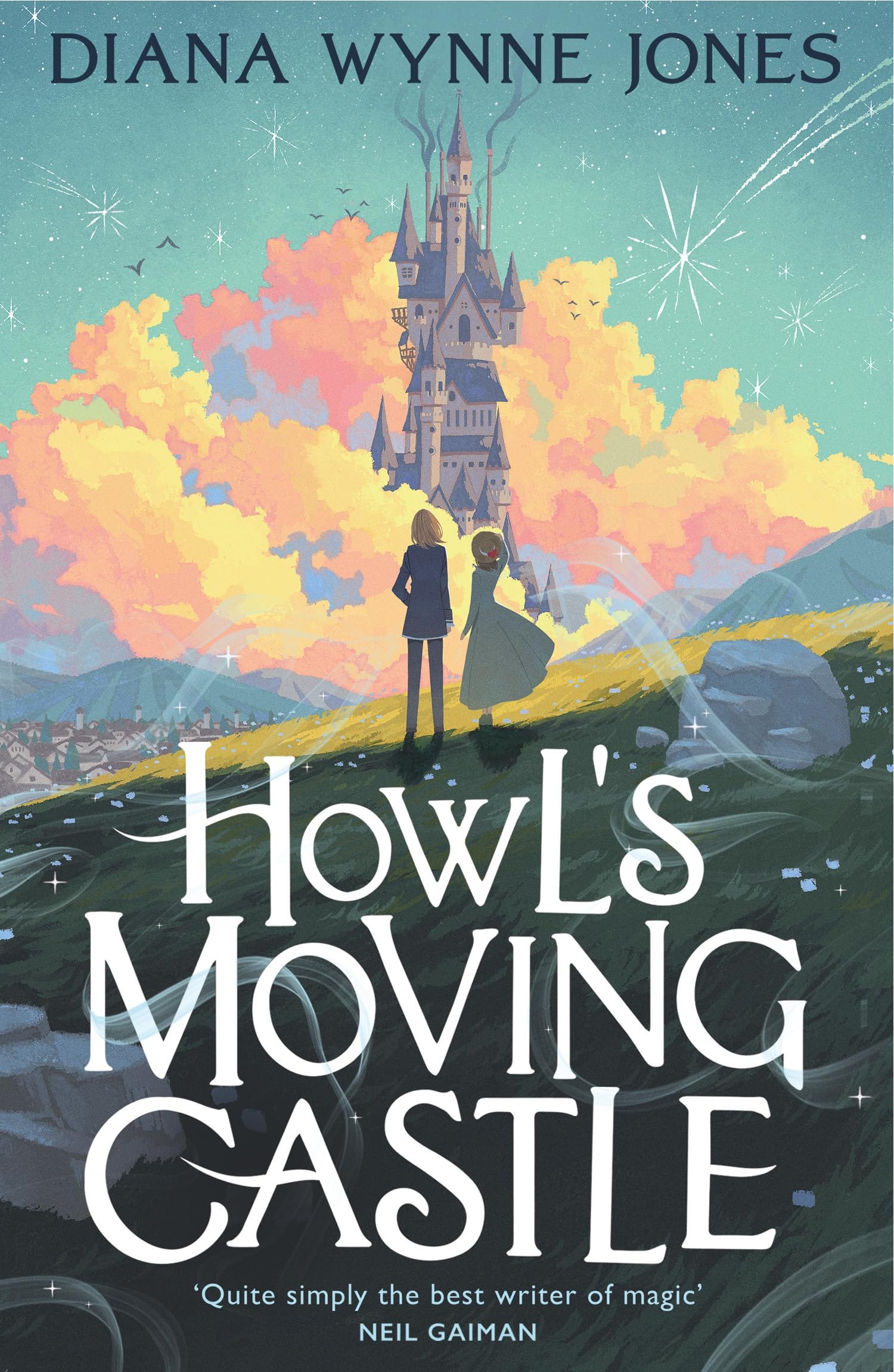
Howl’s Moving Castle by Diana Wynne Jones
“It was odd. As a girl, Sophie would have shriveled with embarrassment at the way she was behaving. As an old woman, she did not mind what she did or said. She found that a great relief.”
Brief Summary:
Sophie Hatter is eldest of three sisters, resigned to a life of dullness. She works in her family hat shop in her hometown of Market Chipping and is far less charismatic and beautiful than her ambitious sisters. But, when the wicked Witch of the Waste curses her into an old woman and binds her from telling anyone about her curse, she ends up seeking refuge in the moving castle belonging to Wizard Howl. Here she strikes a bargain with resident fire demon, Calcifer - she’ll help him break his contract with Howl and he’ll help her break her curse.
My thoughts:
I had no idea that the Studio Ghibli film was based on a book, lest a book from an English author and as a fan, I was incredibly excited to read this. This is definitely written as a children’s book (I imagine the sort of 8-11 year old demographic) and you would have thought in my big age, I’d feel a disconnect but this was just stunning. The film captures the atmospheric dreaminess of the world so wonderfully and if you are a fan of the movie, you will definitely like this.
Be warned though - there are some quite big differences. The war plotline that heavily features in the film is not really present in the book - the war is distantly referred to, but there is no involvement from our main cast of characters and when Howl disappears, it’s not to interfere in the war, but rather it’s to date. This was admittedly, a little strange. Howl is more of a flawed character here, where he enjoys the chase of romantic pursuits, but loses interest once the woman has fallen in love with him. Sophie is also terser than the movie and their romance is incredibly understated in the book compared to the film. There are some other minor character differences: Calcifer is presented more as an acutal demon and Makl is not a child, but an adolescent named Michael.
Thematically, the book focuses more on the expectations on women in society and the characterisation of Sophie reflects this. All in all, this story is simply the definition of whimsy and I can’t really fault it.
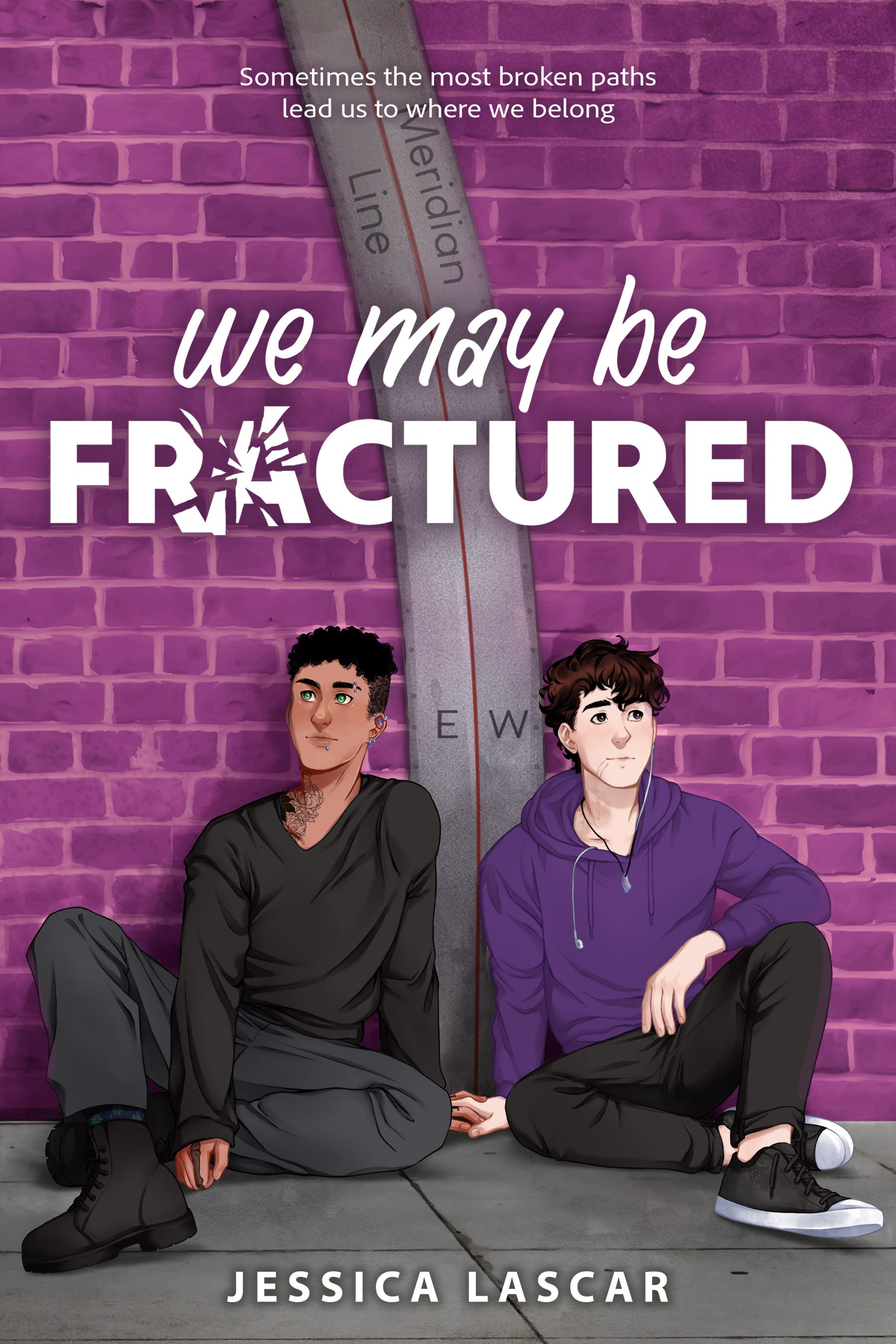
We May Be Fractured by Jessica Lascar
“We may be fractured, sure, but that doesn’t mean we can’t piece ourselves back together.”
Brief Summary:
Done with school and ready to find his “Neverland” in honour of his late sister’s dream, Aaron is about to disappear to Australia. But when he’s caught with weed at a party, he’s sentenced to community service and his plans are put on hold. Here he meets a bunch of other misfits, and in particular, Landon. Mysterious, closed off and referred to by the others as ‘the Psycho’, Aaron is intrigued. This intrigue leads to late night conversations where piece by piece, both of them find themselves letting someone in for the first time. Aaron then has a choice - does he continue with his plans to escape his current life or does he find something worth staying for?
My thoughts:
Buckle in because I have THOUGHTS.
Ugh. I really wanted to like this, I did. When I saw people talking on TikTok about the couple being “Andreil coded” (my beloveds from All For The Game), I was beyond excited. I had also seen the author confirm that the dynamic between Aaron and Landon was “heavily inspired” by Andrew and Neil, but… this went beyond inspiration for their dynamic.
As an avid fanfiction reader, I have mixed feelings about fic authors ‘shaving the serial numbers off’ of fics they have written to amend for publication and although I can’t be certain that We May Be Fractured started life somewhere in the depths of AO3, it definitely reads like a ‘no mafia, no Exy AU’ fic. If it’s the case that this was a fic, in my opinion, Lascar did not make enough amendments to ensure it exists as a distinct story without infringing on Nora Sakavic’s IP and having now seen that she used AFTG in her marketing material, it was a big ick.
NB. Beyond this point contains spoilers for both We May Be Fractured and the All For The Game series. CW for mentions of SA and self-harm.
It’s not just the dynamic that mirrors Andreil, it’s their characters and backstories and even the language used between them. If you’re not familiar with AFTG (probably best), here’s some context on the Andreil relationship:
Andrew Minyard - spent his childhood bouncing between foster homes where he was routinely sexually abused and self-harmed to cope. He later learnt that he had an identical twin (Aaron) who remained with their mother and upon learning that the mother was abusive towards Aaron, he killed her in a staged car accident. The Twinyards then defaulted to the care of their slightly older cousin, Nicky - an out, proud and flamboyant gay man who’s parents had sent him to Germany for conversion therapy. Here he met his boyfriend, Erik, who he maintained a long distance relationship with when he moved back to the States to care for the twins. When Nicky was hate-crimed, Andrew retaliated violently, landing him in juvie and stuck with court-ordered medication which left him in a state of constant mania. When we meet Andrew in AFTG, he is in this manic state, carries knives in the armbands that cover his self-harm scars and often prone to violence, particularly to protect those he loves (which causes the other members of the team to refer to him as ‘the Monster’). He has a difficult relationship with Aaron, who resents him for the car accident, and is incredibly averse to touch.
Neil Josten - leaving behind a trail of false identities and with nothing but a duffle bag and a patchwork of scars from a childhood of abuse, Neil and his mum are on the run from his serial killer father - known as the Butcher of Baltimore and with ties to the Japanese mafia. Neil is just the latest alias and comes after one of his father’s men finally caught up to him and his mother. Neil made it out, his mother didn’t, leaving her burnt remains on the beach. When we meet Neil, he’s paranoid and alone, wary of his new teammates and ready to run at any moment. But he can’t help himself - he loves to play to Exy and he’ll do anything to keep the life he’s starting to cultivate for himself (except running his mouth and starting fights on national TV, apparently).
Andreil - the slowest of slow burns, Andrew and Neil’s relationship develops through the building of trust. They start an ongoing game of truths and piece by piece, they learn to let the other in and eventually, romance follows. Neil is presented as demisexual (they don’t use the word, but he repeatedly says that he “doesn’t swing” except for Andrew). As for Andrew, despite him not particularly hiding the fact, is gay and has enjoyed several casual flings, although, they were never allowed to touch him in return and it was never more than sex. With Neil, it’s different. He’s respectful of Andrew’s boundaries and with a verbal “yes or no” before anything, their physical intimacy builds as their trust does.
So let’s talk similarities….
Landon (Andrew) - spent his childhood bouncing around foster homes while his sister remained with the family. They have a difficult relationship, but Landon remains protective of her and their cousin, Nyle (again, an out and proud gay man who’s personality is very similar to Nicky). It is later revealed that Landon was sexually abused in the foster system and remains averse to touch and intimacy because of it. Much like Andrew, he also self-harmed to cope, had a stint in juvie and is referred to by a similar nickname (the Psycho). Although, the reason for this just seems to be that he went to juvie and now, is a bit emo and broody?
Aaron (Neil) - granted, Aaron’s backstory is different to Neil’s. No mafia, no childhood abuse, no serial killer father and definitely no Exy. Characterisation and thematically, though… it’s similar. In essence, Aaron is waiting to run away from the UK. He wants to start a new life in Australia after the loss of loved ones and he’s grappling between running and enjoying the life he’s started to cultivate. His personality has streaks of Neil’s smartass ways and his arc of starting to enjoy the life he’s building is definitely reminiscent of Neil’s arc in AFTG. Like Neil, Aaron is also demisexual (and I’ll give it to the author, the rep here is good) and carries heavy physical scars (and emotional ones), albeit from the traumatic car accident that took his parents and sisters’ lives, not from his serial killer dad and his life on the run.
The relationship - there’s no denying that the relationship mirrors the build of Andrew and Neil’s in the exchange of secrets and the growth of trust between them. The thing that stood out to me the most though was the language used between them… Landon calls Aaron a liar (as does Andrew to Neil). Landon accuses Aaron of always running, calling him a ‘rabbit’ (again, exactly as in AFTG). They have a bonding moment over their respective scars and they even do the whole “yes or no” thing before touch. There’s also a moment where Landon calls Aaron out for staring that may or may not have been lifted directly from the text of AFTG.
Part of the reason you buy into Andrew & Neil’s characters and relationship in All For The Game is because it burns slowly over the course of three books. We May Be Fractured, therefore, feels condensed, rushed and the final product feels like they’re just watered down versions of other characters.
I can’t say I hated the book and did find myself enjoying it at points. The writing is good on a technical level and as a Londoner, I mostly found it believable as being set there. There was a point where the characters would have walked a long way (approx. an hour) that seemed to have happened in a matter of minutes and I would say there were a few points where the language wasn’t authentically British (the term “soda” being used), but these points were few and far between.
I think if I had went in with the expectation that this was an All For The Game fanfiction, I would have enjoyed it a lot more. As it stands, my expectations didn’t meet my experience and I left feeling enraged at the dilution of some of my favourite fictional characters ever.
WHAT I’VE BEEN DOING
I definitely say this every month, but August has been busy. As per usual, my corporate 9-5 has been “just one of those months” (although at the moment, there does not appear to be any other type of month) and between my usual pub quizzes and catching up with friends, there’s a few particular things I want to talk about.
The Tudors, Natalie Dormer and Wine-Drinking Treaties
For anyone who’s read any of my previous Substack newsletters, you will know that me and Amy have been re-watching the 2007 Showtime drama series, The Tudors. Largely this has consisted of a lot of gay panic watching Natalie Dormer as Anne Boleyn and being entirely unserious about the events (see: referring to Thomas Tallis as “tonsillitis” and saying “I reckon if we were in this time, we’d nick all the cardinals’ caps and play Connect 4 with them”).
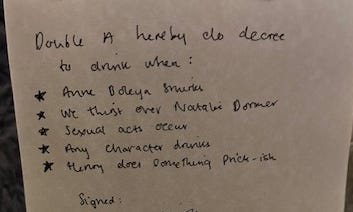
At the beginning of the month, what else were we going to do but turn our regular meet ups to watch the series into a drinking game. Wine at the ready, we formed a Tudor Treaty for the rules and ended up more than a little bit tipsy (4.5 bottles later…)
Leeds Castle (strangely not in Leeds)
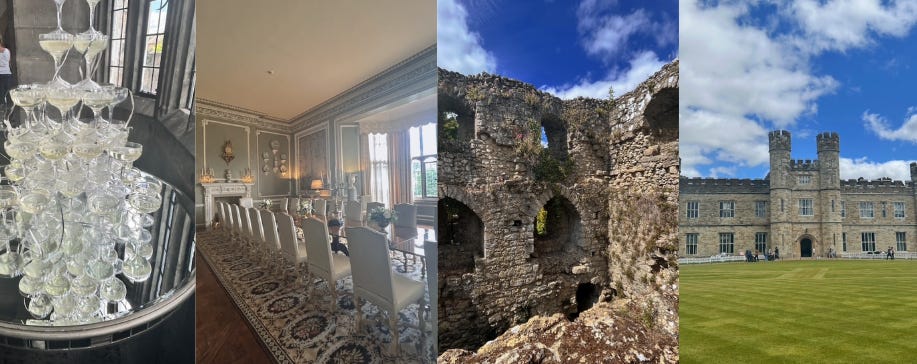
Every time I’ve spoken about my visit to Leeds Castle, it has been tagged with “but it isn’t in Leeds, it’s in Kent”, but I still haven’t figured out why it’s called that…. Anyway, Leeds Castle has a rich history. Originally a medieval castle, it passed through varying English monarchs before Henry VIII transformed it for his first wife, Catherine of Aragon. Until the early 1920s, the castle was passed between several noble families, but in 1924, it was bought by Anglo-American socialite Olive, Lady Baille and transformed into the state we see it today.
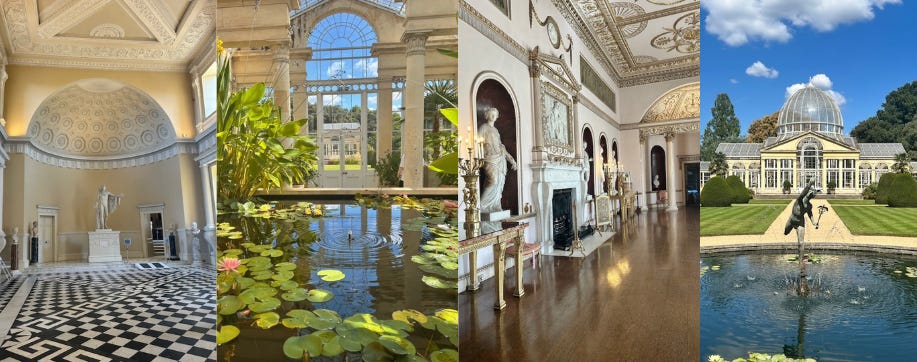
Syon Park (Syon House & Gardens)
Upon the dissolution of the monasteries under Henry VIII, the medieval Syon Abbey was transformed into a grand manor house and gardens estate primarly by the Percy family in the sixteenth century and is the London residence of the Duke of Northumberland. Syon Park refers to the wider estate, containing the manor house and gardens and includes the Grand Conservatory (which I believe has been used as a filming location for Bridgerton).
Reading Festival
Despite my body feeling utterly broken afterwards, I had an incredible time at the Friday of Reading Fest with my ever-wonderful friend, Lana, and got to see some of my favourite artists: Hozier, Chappell Roan and The Kooks.
For those unfamiliar with Hozier (what a man), his live performances always include a short speech about the power of protest, solidarity, compassion and the need for a free Palestine. Surprising absolutely nobody, the BBC therefore, refused to air his set in its entirety. It’s a beautiful speech that I’ve had the joy of seeing live twice now and I really do urge everyone to watch it:
Highlights also included:
Me moaning about the website about the length of the walk from the station (it said 15-20 minutes but that was to the first entrance, after which there was a further 30 minute walk to actual the festival site
Lana struggling in the heat, buying a new t-shirt and flashing the masses as she got changed
In what I can only describe as a fever dream, The Kooks brought out Rebel Wilson and they sang Gangsta’s Paradise together???
Sunburn spotting and bemoaning the return of the booty shorts (I fear we are too old for these to return)
“If straight men hate two things, it’s whimsy and women”
September looks to be a (hopefully) gentler month and I’m off on holiday in early October, so next month’s newsletter will likely be delayed. I’m sure it’ll come eventually so catch y’all soon.
With muchos love, Annie x